
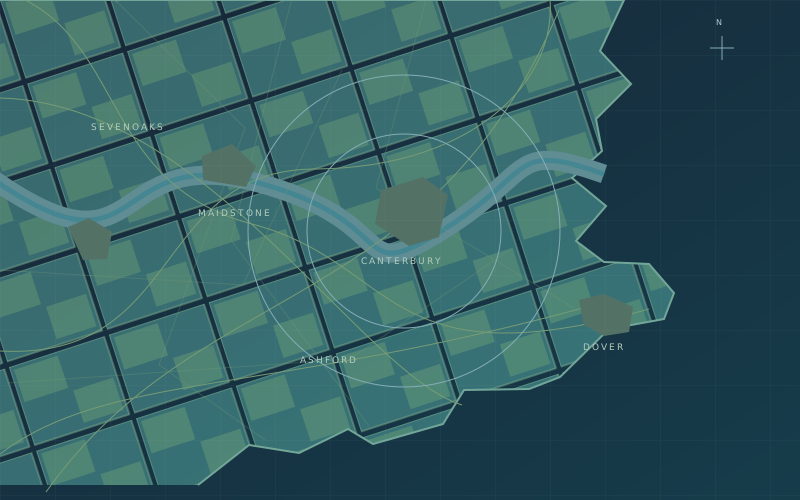
An organisation’s climate exposure rarely ends at its property boundary. Suppliers, transport routes, energy systems, and service providers connect operations to a much wider geography. Understanding that network can change which questions deserve attention, even when direct site exposure appears limited.
Start with critical functions
Mapping every supplier may be less useful than understanding which inputs and services are difficult to replace. Identify critical functions, available alternatives, and recovery time. A small supplier with a unique capability may matter more to continuity than a larger supplier of a readily available input. Operational knowledge is essential to that distinction.
Look for shared dependencies
Two suppliers in different buildings may still rely on the same road, port, power network, or water system. Geographic diversity does not automatically establish operational independence. Explore whether hazards could affect several dependencies together, and record where the network is poorly understood. Gaps in visibility are themselves useful questions for a review.
Use screening to guide conversations
A broad analysis can help prioritise discussions with procurement teams and suppliers. It should not be used to declare a counterparty resilient or unfit without relevant evidence. Ask about continuity arrangements, local conditions, and practical alternatives. Keep the evaluation proportional to the decision and revisit it as the network changes.
Three things to take away.
- Map critical functions as well as physical sites.
- Test whether apparently separate suppliers share dependencies.
- Use screening to inform evidence-gathering conversations.
Further reading
Explore the underlying topics through these reference sources.